A Question of Identity
A couple of weeks ago, I was involved in a ‘doom loop’ discussion with four other Readers during one of Chaplain Jim’s informal, free-ranging ‘Readers in Conversation’ Zoom meetings. We had begun by ruminating on why the Readers’ Day had been postponed and the wider implications for Reader ministry.
Depressingly, the word ‘malaise’ crept into the conversation; but so did the word ‘collegiate’. And the latter set me thinking.
Much of the debate we embarked upon had already been covered in several of Jim’s excellent ‘Stargate Blogs’, especially those written during the past four years…
On 28 October 2024 he wrote: ‘Are Readers a dying breed?’ and the piece included the following quotation attributed to Walter Lippmann, ‘If in the pursuit of the perfect, we wreck the best that is possible, then the longing for the absolute is akin to madness!’
He continued, ‘Lay ministries across the Church of England are blossoming in all sorts of ways. In this diocese we have Readers, Local Lay Leaders who have been through the excellent Sens Kernewek course, worship leaders, pioneer ministers of all sorts, pastoral ministers and lay workers with courses ranging from a dozen hours of training to several years.’
‘It is no wonder that Reader numbers are dropping.’
Subsequent Stargate Blogs expanded on the theme – notably 15 November 2024, 17 October 2025 and 2 January 2026 – and I commend them to you as background to the ‘malaise’ we discussed two weeks ago and to underpin what I have to say today.
I think, for me, the rot began to set in a decade or so ago with the vacuous woke initiative of the introduction of the title Licensed Lay Minister as a replacement/synonym for the simple descriptor, ‘Reader’, under the false pretext that swathes of C of E congregations didn’t understand the role of a Reader.
The revived office of Reader had existed since 1866. It was a ‘vocation’ and Readers fulfilled their ministry publicly by leading worship, preaching and teaching the Word of God, and assisting with the Eucharist, pastoral and evangelistic work.
In many cases, the greatest barrier to public understanding the nature of this role was that Readers were prevented from fully expressing their calling by the restrictive practices of their incumbents! The title endowed an unspoken sense of gravitas and recognition of Reader ministry – as a calling, a way of life and someone who had undergone rigorous academic theological training – not a few weeks attending evening classes!
Indeed, the introduction of the term ‘lay’ diluted the credibility and recognition of the depth and commitment of Reader ministry by immersing it in the swamp of emerging ‘ministries of convenience’. It lost its identity and with it the sense of collegiate belonging felt by its practitioners.
And, by the way, the abbreviation LLM is in fact confusing. On the one occasion I used it, the person making the enquiry thought I had a degree in Law!
This loss of identity continued. For reasons best known to themselves, the Central Reader Council decided the publication The Reader was to become Transforming Ministry. More dilution, dumbing down and further erosion of our sense of identity. I have yet to be given a coherent explanation of what the apparently inclusive phenomenon of ’transforming ministry’ is. And what exactly does the Central Reader Council do for us here in Cornwall at the front line of rural Reader ministry? Answers on a postcard please.
I believe we have lost our sense of belonging and need to rediscover the inherent collegiate nature of our vocation. Being “collegiate means fostering a spirit of cooperation, shared responsibility and mutual support. Indeed, when I began my Reader journey in the Diocese of Lincoln, we did have ‘college’ meetings and I recall there was a national College of Readers, since defunct.
This brings me back to the origin of this discussion. The decreasing attendance at Reader events. I accept that many of my colleagues are feeling the effects of Anno Domini, both physically and logistically, and that others want to fulfill their ministry in their parishes and leave it at that.
Personally, I believe that the structure of Reader gatherings can be made more ‘collegiate’ by adhering to a policy of simple plenary sessions throughout the day and not trendy educational ‘cop-outs’.
Having travelled to a gathering to hear expert speakers, I don’t want to be divided into workshops for inexpert discussions, only to reconvene for diluted, inadequate summaries of other deliberations. I want to be in the same room as all my colleagues and hear all their questions and the answers given at the same time. To feel part of a ‘college’.
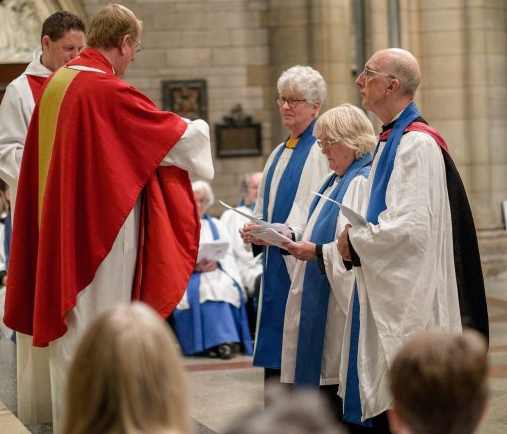
The continuation of the annual Celebration of Reader Ministry service in the Cathedral is a ‘must’ and we should all feel some sense of duty to attend this, plus the Annual General Meeting immediately following it.
Perhaps the concept of ‘quiet days’ as collegiate events could be resurrected, especially if these were what it says on the tin – quiet, thoughtful prayerful days. Yes. And with long silences!
The bottom line, however, depends upon us and our commitment to our identity and the ‘college’. As ex Prime Minster, John Major, once said to his challengers for leadership, “Either to put up or shut up”.
I leave you with one last thought.
Although I sincerely thank our valiant diocesan Reader ministry support team for all their efforts under lean and mean circumstances, I do feel there is a rift between them and us – aggravated by the bureaucratic burdens of safeguarding, relicensing and the dreaded HR.
I would ask them to look hard at how decisions are made and to bring the ‘collegiality’ of Reader ministry back to the top of the agenda. To enhance the core identity of Readers and to lift them out of the lay ministry ‘swamp’ and restore their rightful place, welded as equals alongside ordained ministry.